
The Growth Triad: Mastering Marketing Innovations, Ad Campaigns, and Market Analysis
Marketing is no longer just about catchy slogans or a decent budget. It is a brutal fight for attention in an ecosystem that changes every time an algorithm sneezes. I've seen businesses crumble because they leaned too hard on legacy tactics, and I've seen startups explode overnight because they understood one simple truth: adaptation is everything.
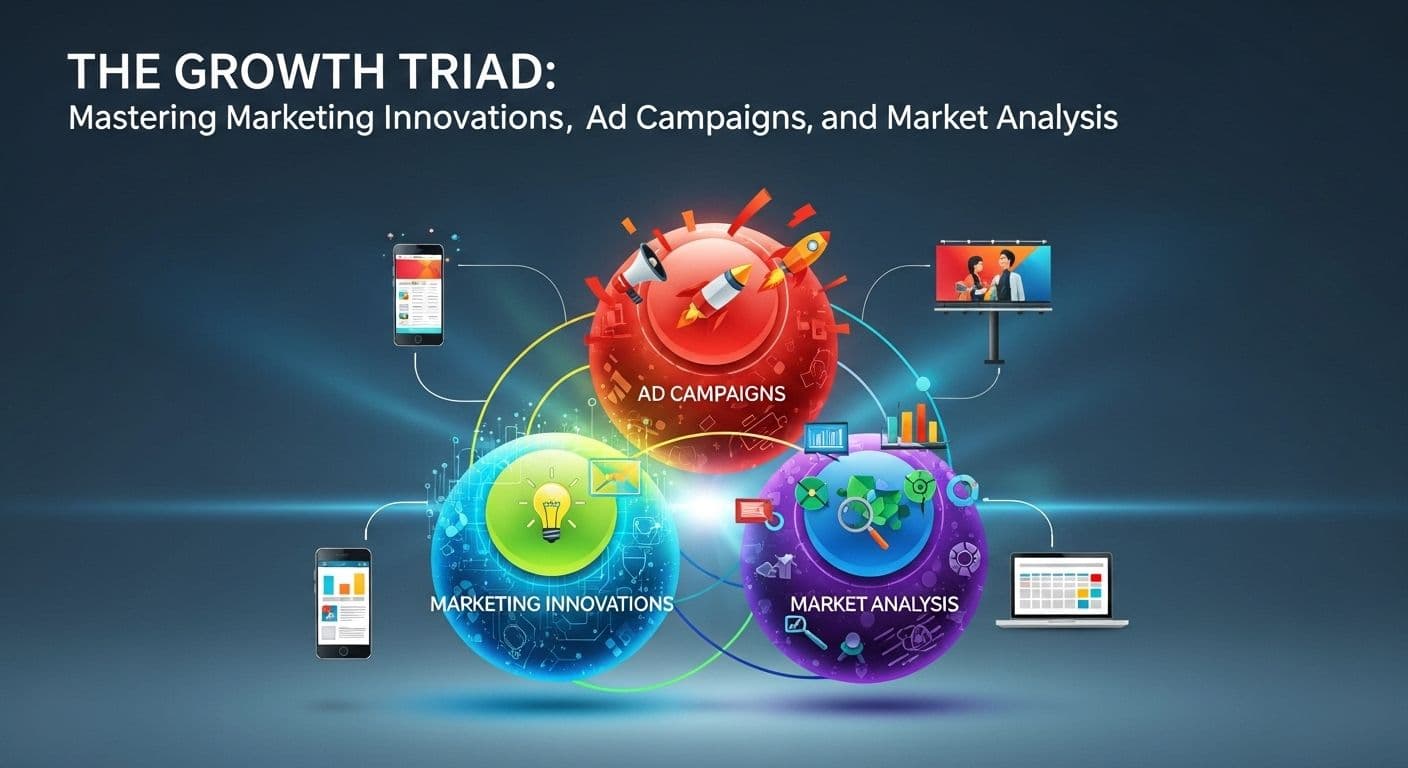
If you are looking for clarity on marketing innovations, ad campaigns, and market analysis, you are looking for the blueprint of modern business survival. You cannot separate these three. Innovation fuels the ads. Analysis directs innovation. It is a feedback loop.
This isn't a gentle introduction. We are going straight into the mechanics of what actually works right now.
Marketing Innovations: The Tech That Actually Matters
Marketing innovation isn't just about using shiny new toys. It is about efficiency and personalization at scale. If your stack isn't reducing friction or increasing relevance, it's just overhead.
Generative AI Beyond Content Creation
Everyone uses ChatGPT to write mediocre blog posts. That's not innovation; that's laziness. The real power of Generative AI lies in predictive modeling and data synthesis.
I use AI tools now to simulate focus groups. Seriously. You can feed an LLM your customer personas and ask it to predict objections to a new product launch. It’s not perfect, but it gets you 80% of the way there before you spend a dime on real research. This compresses weeks of strategy work into an afternoon.
Furthermore, look at dynamic asset generation. We are moving toward a world where the video ad a user sees is generated in real-time based on their browsing history. Not just the text overlay, but the actual visual components. That is the bleeding edge.
The Death of the Third-Party Cookie
This has been coming for years. Google keeps delaying it, but the writing is on the wall. Privacy-first marketing is the only way forward.
The innovation here is the shift to Zero-Party Data. This is data a customer intentionally shares with you. Think quizzes, preference centers, and interactive onboarding. If you aren't building mechanisms to collect this right now, your ad campaigns in 2025 will be flying blind. You need to own your audience, not rent it from Zuckerberg.
Voice Search and Conversational Commerce
SEO is morphing. People don't type "best running shoes" as much anymore. They ask Siri, "What running shoes are good for flat feet and cost under $100?"
Optimizing for this requires a semantic shift. You need to answer specific questions directly. Your content needs to be structured for Natural Language Processing (NLP). If your site is just keywords stuffed into paragraphs, voice assistants will ignore you.
Ad Campaigns: Creative is the New Targeting
For a decade, media buying was math. You tweaked the audience settings on Facebook Ads Manager until the ROAS (Return on Ad Spend) turned green.
That era is dead. Automation and AI have leveled the playing field on bidding. The algorithm knows who to target better than you do. So, what is the variable? The Creative.
The Psychology of the Scroll-Stop
Average attention spans on social feeds are under two seconds. Your ad campaign fails or succeeds in the first 1.5 seconds.
I tell clients to focus on the "Hook Rate" (3-second video views divided by impressions). If your hook rate is under 30%, your ad is trash. It doesn't matter how good the offer is if nobody sees it.
Effective hooks rely on:
- Pattern Interrupts: Visually jarring movements or colors that break the flow of the feed.
- Immediate Benefit: "Fix your back pain in 5 minutes."
- Negativity Bias: "Stop doing this if you want to lose weight."
Cross-Channel Consistency vs. Native Formatting
This is where brands mess up. They take a TV commercial, crop it to 9:16, and throw it on TikTok. It looks polished, corporate, and completely out of place.
Users hate ads that look like ads. The most successful campaigns I've run recently utilize User Generated Content (UGC). Lo-fi, shot on an iPhone, slightly shaky. It feels native. It builds trust because it looks like a recommendation from a peer, not a mandate from a corporation.
However, the message must be consistent. The value proposition you scream on TikTok must match the headline on your landing page. Disconnect creates friction. Friction kills conversions.
The Return of Brand Advertising
Performance marketing (direct response) has ruled for too long. But with customer acquisition costs (CAC) rising, you can't just arbitrage your way to profit. You need a brand.
We are seeing a swing back toward brand awareness campaigns. Why? Because when someone trusts your brand, they click your ad faster and convert higher. It lowers your CAC in the long run. Don't measure brand campaigns by immediate sales. Measure them by "Share of Search"—is the volume of people searching for your brand name increasing?
Market Analysis: Data Without Context is Noise
You have too much data. Google Analytics 4, CRM data, ad platform metrics, heatmaps. It is overwhelming.
The job of a market analyst today isn't to gather data. It is to ignore the wrong data.
The Attribution Illusion
Here is a hard truth: You will never know exactly where every sale came from.
A customer sees your Instagram Reel (no click). Three days later, they see a YouTube ad (no click). A week later, they Google your brand and buy. Google Analytics credits "Organic Search." Facebook credits the Reel. YouTube credits the video.
If you rely solely on platform-reported data, you will make bad decisions. You need Marketing Mix Modeling (MMM) or incremental lift testing. Turn off Facebook ads for a specific region and see if sales actually drop. If they don't, those ads weren't driving net new revenue; they were just claiming credit for sales that would have happened anyway.
Competitor Intelligence
Don't reinvent the wheel. Steal the blueprint.
Tools like SEMrush or Facebook Ad Library allow you to see exactly what your competitors are doing.
- Look for longevity: If a competitor has been running the same ad creative for three months, it is making money. Analyze it. Why does it work?
- Analyze their gaps:Read their 1-star reviews. What are customers complaining about? That is your marketing angle. "We are the software that actually has customer support."
Predictive Analytics
Historical data tells you what happened. Predictive analytics tells you what will happen.
Using regression analysis, you can forecast demand based on seasonality and market trends. This isn't just for Fortune 500 companies anymore. If you know that search volume for your industry peaks in November, you shouldn't be testing new creatives in October. You should be scaling winners. Timing your market analysis is just as critical as the analysis itself.
Integrating the Triad
So, how do you put this together?
1. Start with Analysis: Look at the market gaps and your competitor's weaknesses. Identify the customer pain points.
2. Deploy Innovation: Use AI to iterate on angles and identify the best platforms for your audience.
3. Launch Campaigns: Build creative that speaks directly to the pain points found in step 1, using the formats identified in step 2.
4. Loop: Feed the campaign performance data back into the analysis.
It is a cycle. The businesses that spin this cycle the fastest win.
The Bottom Line
Marketing is volatile. Strategies that printed money six months ago might burn cash today.
You have to stay fluid. Embrace the chaos of innovation, respect the psychology of ad campaigns, and be ruthless with your market analysis. If you aren't uncomfortable with how fast things are moving, you aren't moving fast enough.

About Amir Husen
Amir Husen is a Content Writer, SEO Specialist & Associate at ICS Legal, a leading UK-based immigration law firm. He specialises in crafting high-quality, SEO-optimised content that helps individuals find trusted immigration lawyers near them. Amir’s work focuses on key topics such as the UK Spouse Visa, settlement routes, and British nationality applications. Through his writing and SEO expertise, he ensures that ICS Legal’s clients receive clear, reliable, and up-to-date immigration guidance.