

Most marketing conversations in 2026 are about inputs: which channels to invest in, which creative formats are working, how to use AI to generate content faster. These are legitimate questions. They are also, increasingly, the wrong ones to be optimizing around.
The teams pulling away from their competitors right now are not the ones with the best creativity or the biggest budgets. They are the ones who have collapsed the time between a campaign signal and the decision that responds to it. The feedback loop, not the campaign itself, has become the primary unit of competitive advantage in digital marketing.
What the Feedback Loop Actually Is
Every campaign generates signals constantly: which audience segments are engaging, which creative variants are holding attention, which messages are converting and at what point in the funnel, which channels are delivering acquisition at a sustainable cost and which are quietly bleeding budget on low-intent traffic.
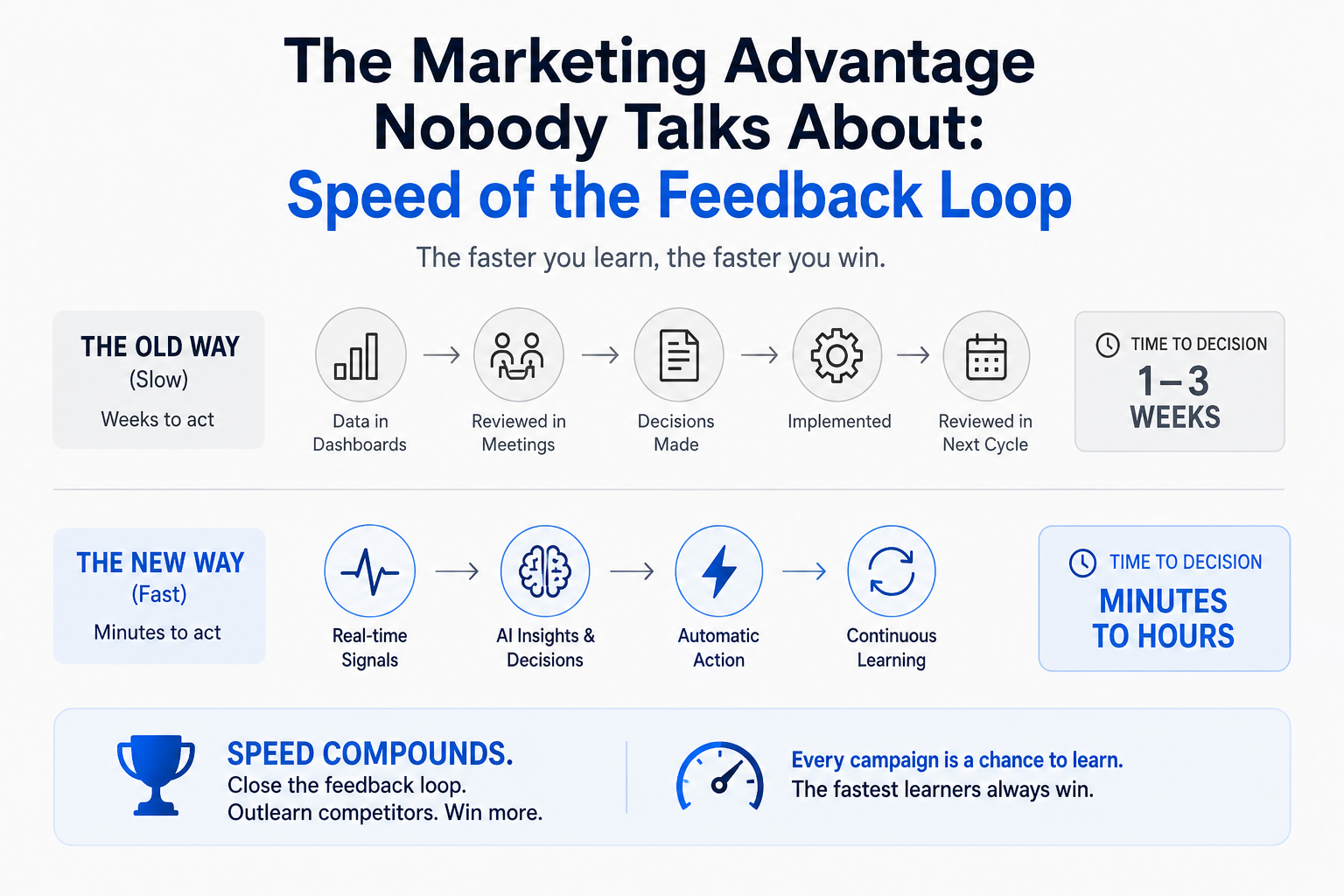
Traditionally, those signals traveled through a slow, lossy pipeline. Data aggregated in a dashboard. A marketing manager reviewed the dashboard weekly. Insights got discussed in a meeting. Decisions got made, briefed to the agency or creative team, implemented, and reviewed again in the next reporting cycle. The total elapsed time between a signal emerging in campaign performance and a decision responding to that signal was often measured in weeks.
In a stable, slow-moving market, that lag was manageable. In the current environment, where audience behavior shifts within days, platform algorithms update continuously, and competitor campaigns respond in real time, a two-week signal-to-decision gap is a structural disadvantage that compounds with every campaign that runs.
Why This Is Happening Now
Two things converged to make the feedback loop the central competitive variable, and both happened faster than most marketing teams anticipated.
The first is that the data infrastructure required to generate real-time campaign signals became accessible to mid-market teams. Dashboards that once required enterprise-level analytics infrastructure to build are now available as product subscriptions. A team of three marketers can now have access to signal quality that five years ago required a dedicated data team.
The second is that AI-assisted decisioning removed the human bottleneck from a specific category of campaign decisions. Not all decisions, and not the ones requiring strategic judgment. But the category of decisions that used to require a human to review data, form a hypothesis, write a brief, and wait for implementation has shrunk significantly. Budget reallocation across ad sets, creative rotation based on engagement signals, audience expansion triggered by conversion rate thresholds: these are decisions that can now happen in near-real time without waiting for a weekly review.
The result is a growing performance gap between teams that have restructured their campaigns to take advantage of this and teams still running campaigns the way they ran them three years ago, just with better tools layered on top.
The Three Structural Moves That Close the Gap
The teams operating with the fastest feedback loops share three structural characteristics that are worth naming specifically, because they're not primarily technology decisions. They process decisions that happen to be enabled by technology.
They separated creative decisions from performance decisions. Creative direction (what to say, how to say it, which visual language represents the brand) still moves through a human review process that involves judgment, taste, and strategic intent. Performance decisions (how much budget to allocate to which audience, which variant to serve more aggressively, when to pause an underperforming placement) operate on a faster, more automated cadence. The teams struggling most with feedback loop speed have conflated these two categories, meaning every budget decision waits for the same creative review process that requires senior judgment.
They defined the signal threshold before the campaign launched. Deciding in advance what constitutes a meaningful signal removes the most time-consuming part of the review process: debating whether the data is conclusive enough to act on. Teams that define upfront what engagement rate, conversion rate, or cost per acquisition threshold will trigger a specific decision can act on that signal the moment it appears, without convening a meeting to discuss whether the result is significant.
They built the response into the campaign architecture, not the review process. The most sophisticated version of this is campaigns that are structured with pre-approved responses baked in: if audience segment A outperforms segment B by a defined margin, budget shifts automatically within pre-set parameters. If a creative variant hits a defined engagement threshold, it gets increased distribution without requiring manual approval. The decision has already been made. The campaign is executing it. For companies whose marketing promises a seamless digital experience, the product layer has to be built to deliver it. Teams working with a mobile app development company that integrates AI-accelerated development tend to close that gap faster than those building in isolation.
What This Means for Marketing Teams Right Now
The practical implication is not that every team needs to automate their campaigns or invest in expensive technology. It's that every marketing leader should be able to answer one question honestly: how long does it currently take, from the moment a meaningful signal appears in campaign performance to the moment a decision responds to it?
If the honest answer is more than a week, there is likely a structural process issue creating that lag, not a technology limitation. The tools to close that gap are accessible. The process decisions that let a team actually use them are the harder part, and the part most marketing transformations skip.
The marketing teams worth watching in 2026 are not the ones running the most innovative campaigns. They are the ones that built the infrastructure to learn from every campaign faster than their competitors can.