Why Your Brand Strategy Is Writing Checks Your Product Can't Cash
Every CMO has lived this moment. The campaign lands well. Engagement climbs. Qualified leads start moving through the funnel. And then, somewhere between the promise the marketing made and the experience the product delivered, the conversion stalls.
The instinct is to fix the campaign. Tighten the messaging. Adjust the targeting. A/B test the landing page. But in a growing number of cases, the problem is not the campaign at all. It is that the brand strategy has outpaced the product's ability to deliver what the brand is promising.
In 2026, that gap is wider than it has ever been and more expensive than most marketing leaders are accounting for.
The Personalization Promise Is Exposing a Product Infrastructure Problem
The dominant direction of brand strategy over the last three years has been toward hyper-personalization. Relevant content at the right moment, dynamic experiences that respond to user behavior, messaging that feels less like broadcasting and more like a conversation. Customers have come to expect it. Platforms have made it increasingly achievable to promise.
What the platforms have not solved is the back-end infrastructure required to actually deliver it. Personalization at scale requires clean data pipelines, flexible product architecture, and real-time decisioning systems that most mid-market companies do not have. What they have is a CRM, a CDP they are underutilizing, and a marketing stack that is generating signals nobody is acting on.
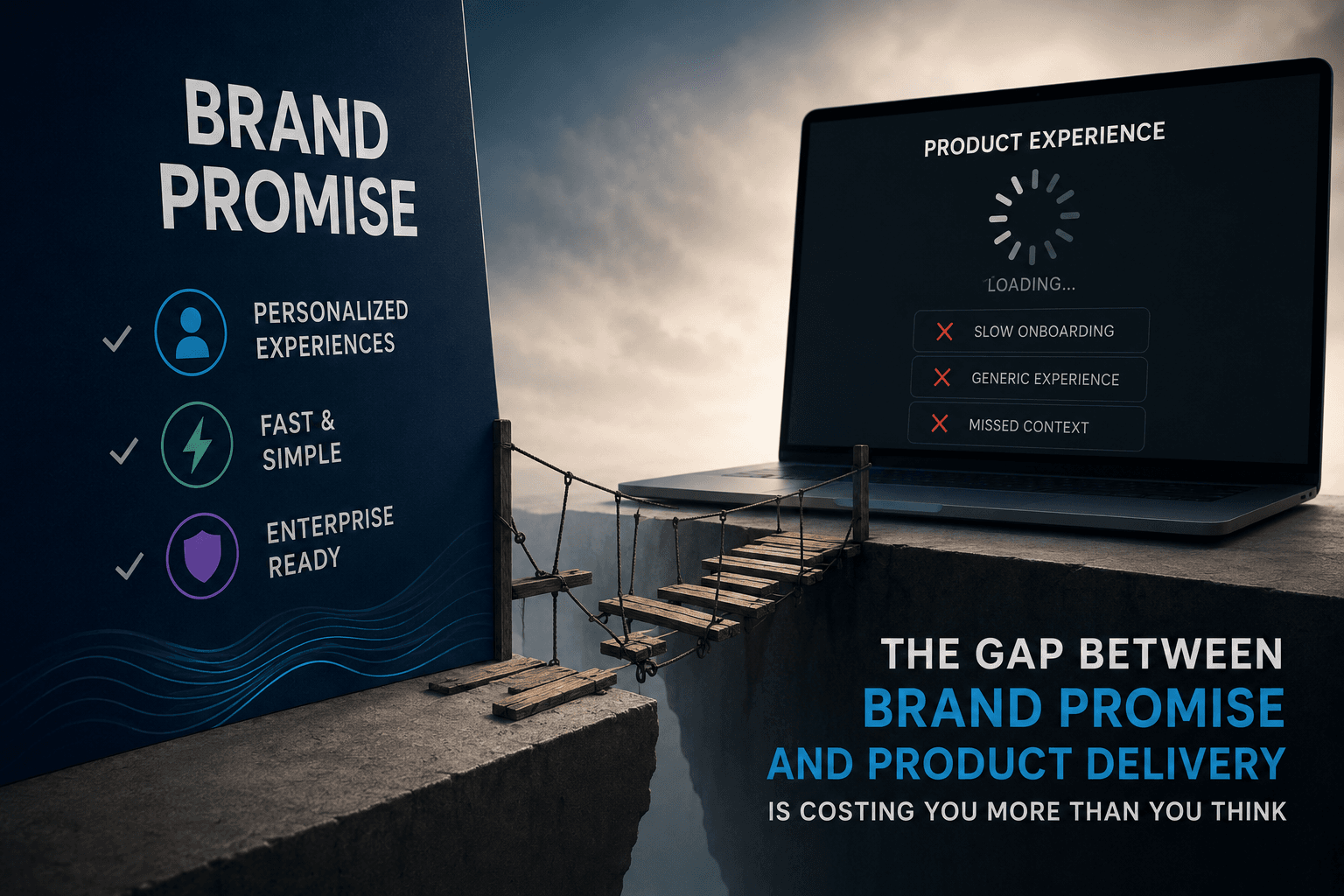
The result is a brand that promises a personalized relationship and delivers a generic one. And in competitive markets where the cost of a broken promise is a churned customer and a negative review, that gap has a measurable dollar value.
The Three Places Brand Strategy Breaks at the Infrastructure Level
Marketing leaders rarely think of product infrastructure as their problem. But when brand strategy fails to convert, the cause is often in one of three places that sit closer to engineering than to creative.
The experience does not match the message at the moment of truth. A brand built around speed, simplicity, or intelligence needs a product that is fast, simple, and intelligent at the exact moment a new user arrives. Onboarding flows built on legacy architecture, slow load times on mobile, or manual processes dressed up in automation language do not just underperform. They actively erode the brand equity the marketing team spent budget building.
Data exists but does not inform the experience. Many organizations are sitting on behavioral data that could power meaningful personalization but lack the integration layer to act on it in real time. The marketing team knows what customers are doing. The product does not respond to it. That disconnect shows up as generic in-app experiences, poorly timed outreach, and recommendations that miss the context entirely.
The product cannot support the campaign's implicit commitment. This is the subtlest and most costly version of the problem. A campaign that positions a platform as an enterprise solution attracts enterprise buyers. If the product cannot support enterprise security requirements, data residency needs, or the integration ecosystem those buyers expect, the marketing worked and the business still lost. The campaign created demand the product could not serve.
What Closes the Gap
The CMOs navigating this most effectively in 2026 are doing something that sits outside the traditional marketing remit: they are getting involved earlier in the product and technology conversation.
Not because marketing should own engineering decisions, but because the brand strategy that will hold up under scrutiny is one built on an honest assessment of what the product can actually deliver today, what it will be able to deliver by the time the campaign runs, and what infrastructure investments are needed to close the gap between the two.
That means marketing leadership needs a seat at the roadmap conversation, not to influence features, but to ensure that the capabilities being promised in market are being built on a timeline that supports the promise. It also means understanding which parts of the product experience are creating brand drag so that investment is directed at the highest-leverage points.
For companies building or scaling digital products, this kind of alignment between brand strategy and product capability is increasingly a competitive differentiator. Teams that work with development partners like AppMakers USA are able to build the underlying systems that make brand promises operationally real: the personalization infrastructure, the integration layers, the mobile and web platforms that deliver the experience the brand is selling.
The Metric That Reveals the Gap
If you want to know whether your brand strategy has outpaced your product, there is one metric worth examining before any other: the drop-off rate between marketing-qualified lead and activation.
When a prospect converts because the brand promise resonated and then disengages before they experience value, the problem is almost never the sales process. It is the gap between what the marketing said and what the product did. That gap is the brand strategy's problem, even if the engineering team has to solve it.
The best brand strategies in 2026 are not just better stories. They are commitments the entire organization is organized around delivering. Marketing leaders who understand that distinction, and who have the organizational influence to act on it, are the ones building brands that compound rather than leak.